Image
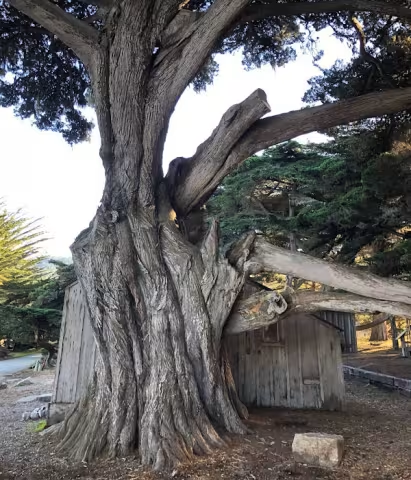

Photo credit: Gnarly Cypress at Whalers Cabin, ©Ernie Long
Point Lobos State Natural Reserve is renowned around the world for its natural beauty. But before it became a California State Park in 1933, humans visited or lived on what is now Point Lobos for many millennia. Archeologists have determined that indigenous peoples occupied Point Lobos going back some 12,000 years.
Between those ancient origins and today, many groups of people called Point Lobos home.
Below you can read more details of the history of humans within Point Lobos. This rich story includes indigenous Rumsen-Ohlone peoples who lived in villages around Point Lobos and camped seasonally within what is now the Reserve for millennia; invading Spaniards who arrived in the late 1700s; Chinese fishing families who established a village in the mid-1800s; Portuguese who hunted whales in the late 1800s; American industrialists who mined rock, shipped coal, and planned housing developments starting in the late 1800s; Japanese abalone divers who harvested and shipped cans of the then-abundant sea snails to hungry Asian markets at the turn of the 20th century; and the preservationists who sought to protect Point Lobos so its natural beauty would be preserved forever.
The Rumsen Ohlone (Room-sen Oh-lone-ee) indigenous people and their ancestors lived in the Point Lobos area for thousands of years before the Spanish explorers arrived.
These indigenous peoples lived in small villages near Point Lobos where they had sources of fresh water. They traveled to different areas in and around what is now Point Lobos throughout the year to hunt and gather food where it was most plentiful.
Because of the moderate climate, nearby sources of fresh water, and ample food supply, Rumsen tribes camped seasonally at Point Lobos for more than 2500 years; their campsite at nearby San Jose Creek is the largest in Monterey County.
Over 45 areas within the Reserve have been identified as indigenous sites. Portable and bedrock mortars, projectile points, and massive shell mounds, or midden heaps, are all present.
The Rumsen people lived in harmony with nature, without trying to control or change it. They used boats made of local tule reeds to fish and reach remote areas where they gathered treats like cormorant eggs.
In what is now known as Whalers Cove, families gathered fish, mussels and abalone.
Discarded shells mixed with the soil and charcoal from campfires to create what we now call shell middens. Remnants of these long discarded shells often can be seen on the trails of Point Lobos today.
As part of its colonizing of the New World, Spain claimed land that includes Point Lobos. They called this area "Alta California." Spanish governor Gaspar de Portola likely surveyed the coast from a high knoll south of Whalers Cove.
The Spanish mission built in nearby Carmel. Soon the Spanish brutally eradicated the local Rumsen way of life. Rumsen people were forced to leave their seasonal villages and work on the mission grounds where most died.
Spanish and Mexican ranchers grazed their cattle in nearby meadows, but there was little human activity in Whalers Cove during this time.
While their numbers were decimated under Spanish rule, Rumsen people did survive. Descendants of the Rumen-Oholone people live in the area today. Some still practice the art of boat making and fine basket weaving. These are arduous, time-consuming tasks. It can take two years to finish a basket!
From about 1850, four or five Chinese fishing families lived on the west side of Whalers cove, harvesting the rich waters of the bay until about 1879.
The families built their fishing village residences from the supplies at hand. One of those homes still stands. Known today as Whalers Cabin, it houses the museum of human history at Point Lobos. The cabin is one of the oldest wood-frame buildings of Chinese origin remaining in Monterey County.
Pine and redwood lumber were used for siding, and square nails can still be seen. Originally, the floor was packed earth. The foundation consisted of hand-hewn logs that ran the length and width of the building. The plank floor was added near the end of the 19th century. Six whale vertebrae provide support for the floor joists, which rest on granite piers supplied from the nearby quarry.
These villagers eventually moved to other locations on the Monterey Peninsula.
The landscape back then looked very different than it does today, as there were far fewer trees surrounding Whalers Cove.
A granite quarry operated in Whalers Cove from 1854 to 1860. It employed 35 men. Rock blasted out of the walls along Whalers Cove was shipped out of Point Lobos and used for the U.S. Mint in San Francisco, and the Mare Island Naval Shipyard.
The annual migration of gray whales, from Alaska to Baja, Mexico attracted Portuguese whalers to Point Lobos in 1862. The whalers formed the Carmelo Bay Whaling Company and built their residences on the south side of Whalers Cove.
Whaling -- the very dangerous practice of killing whales and processing their blubber for oil -- was a short-lived industry at Point Lobos. Around 1880 the less expensive kerosene, a fossil fuel supplanted whale oil for lighting oil lamps. And so began the demise of whaling at Point Lobos, an industry that lasted less than 20 years.
After the Portuguese immigrants stopped whaling, they turned their efforts to farming and cheese making.
Descendants of these Portuguese settlers still live in the area today.
Back in 1890, the Carmel Land and Coal Company divided the beautiful land of Point Lobos into 1,000 lots for housing, hoping to create "Point Lobos City," later called "Carmelito."
But one forward-thinking man, who became a conservationist changed everything.
A.M. Allan, an engineer from Illinois, was hired to manage the nearby coal mine and develop the Carmelito subdivision.
But Allan had never seen a place as breathtaking and wonderful as Point Lobos. He and his wife, Satie, thought this unique patch of California coastline should be protected.
In 1989, A.M. Allan used his resources to buy most of the land. A year later, he put up a gate, Charged visitors 50-cents a vehicle to explore Point Lobos, and asked them to follow rules to preserve the environment.
It took Allan 30 years to buy back the lots that were sold for development, but he succeeded in the end to protect all of Point Lobos.
Alexander Allan, who owned Point Lobos, entered into a business partnership with Japanese marine biologist, Mr. Gennosuke Kodani. They established and operated an abalone fishery in 1898.
Kodani brought experienced abalone divers to Point Lobos from Japan. They harvested unusually large abalone from the waters around Point Lobos. The abalone was harvested and then canned and shipped to Asia where there was an appetite for the sea snail.
In 1902, Kodani built an abalone cannery on the flat surface created as part of a granite quarrying operation. Today the area is known as Cannery Point and serves as beautiful scenic overlook.
The full-fledged partnership between Allan and Kodani continued for over 30 years, from l898 to 1930.
In 1899, A. M. Allan laid narrow-gauge railroad tracks from Monastery Beach to Coal Chute Point for the purpose of transporting sand to ships in Whalers Cove. Point Lobos saw a flurry of industrial activities over the next three decades, including cattle grazing, vegetable farming for the San Francisco markets, lumbering and shipping of redwood from the nearby Gibson Creek area, a gravel quarry in The Pit, and dairy farming.
The Point Lobos Dairy began operation in 1903 and ceased in 1954. It marketed Jack cheese and for a time sold milk door-to-door before selling it wholesale.
The State of California purchased Point Lobos from A. M. Allan's heirs for $631,000 in 1933.
Although the abalone cannery at Whalers Cove was shut down, Japanese divers continued to harvest abalone, which was a delicacy in their homeland. Abalone diving at Point Lobos continued until shortly before World War II.
In 1941, the U.S. Army Coastal Defense Squad used the Whalers Cabin for headquarters just after the Japanese attack on Pearl Harbor.
From 1942 to 1944, the U.S. Air Force used Point Lobos as a long range radar site. Ninety men were billeted in tents below Rat Hill.
In 1943, the U.S. Army established a training school for amphibious landing craft at Point Lobos. The Whalers Cabin served as quarters for eight sergeants of the 543rd Amphibious Brigade involved in the training of landing craft operations.
In 1960, Point Lobos was established as the first underwater reserve in the United States. Some 750 acres of ocean waters adjacent to Point Lobos State Natural Reserve were set aside to create one of the nation's first underwater reserves accessible to divers for education. Later that area was increase significantly to 5.5 square miles to protect one of the richest underwater habitats in the world.
Because the terrestrial area of Point Lobos is only about 500 acres, there is more area devoted to exploration underwater than above water.
The Point Lobos State Marine Reserve (SMR) is part of a larger Marine Protected Area (MPA) with strict no-take rules for any organism within the protected area.
Today, divers continue to explore the underwater park surrounding the terrestrial Point Lobos State Natural Reserve. Divers will encounter waters 60 to 100 feet deep full of abundant marine life, sea caves, and underwater pinnacles.
The dive area within the State Marine Reserve extends from Granite Point on the north end to Guillemot Island on the south end.