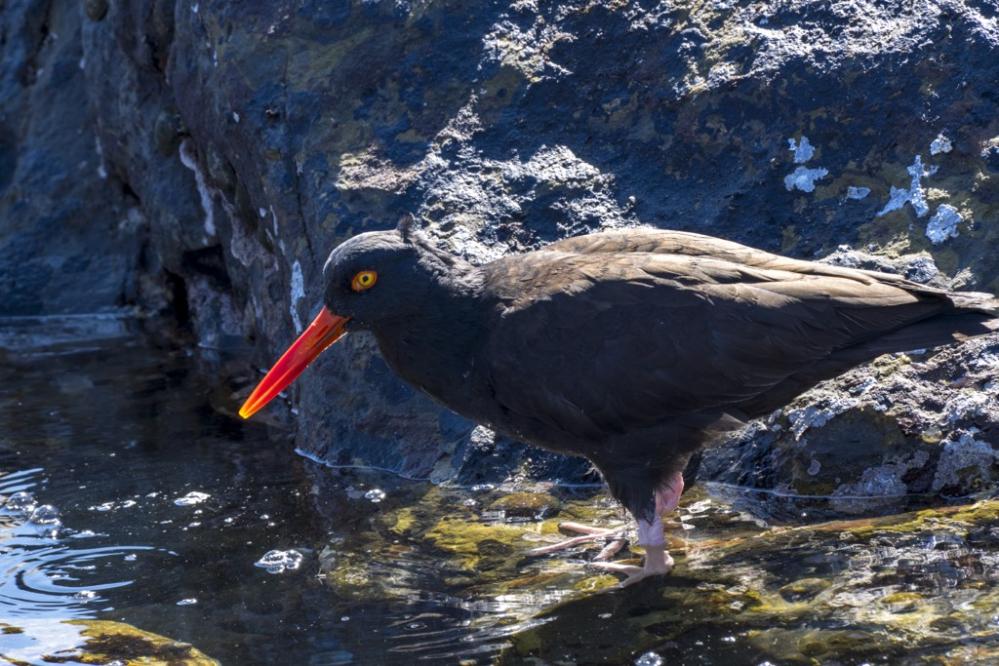
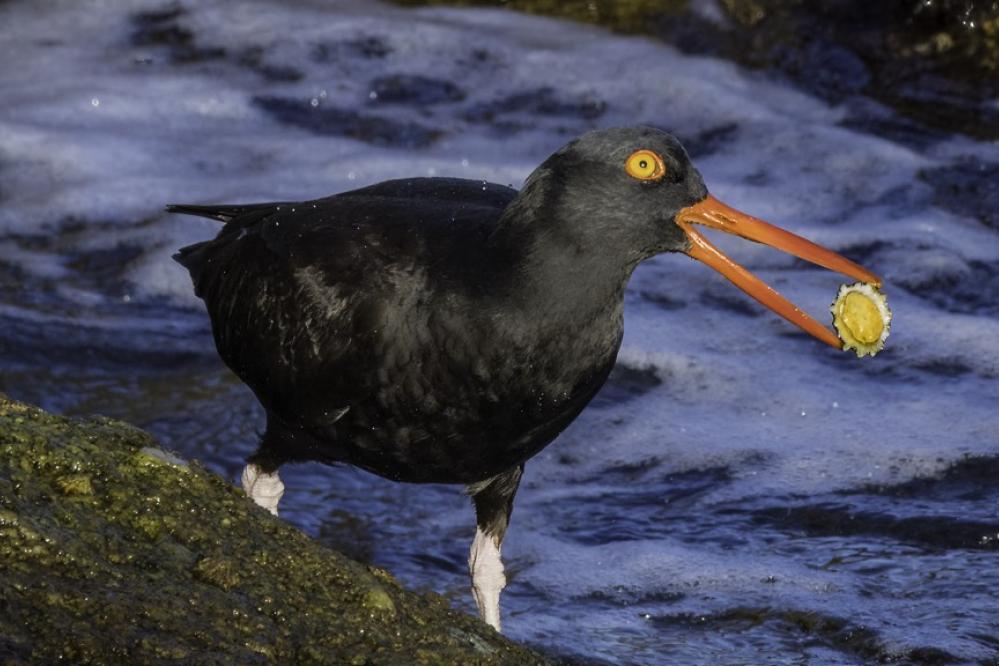
These birds are perhaps the most iconic shorebirds of Point Lobos. Their comical – one could even say caricature-like looks – make them entertaining to watch. And they are nice enough to call attention to themselves with their loud calls from land and while in the air. Once you get to know their calls they are easy to find despite their very dark feathers, which are actually brown. Except for their bright red/orange bill, they blend in very well with the rocks they occupy.
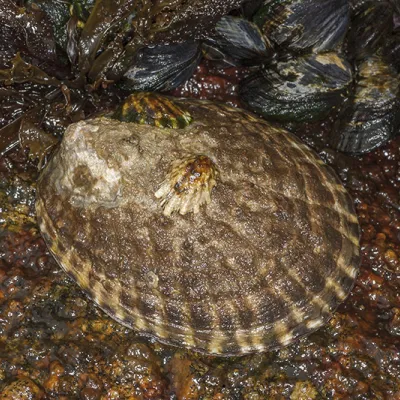
The name of the oystercatcher is a bit misleading. Our local birds mostly eat mussels and limpets. Their east coast cousins, the American Oystercatchers, can find oysters in beds shallow enough to “catch” them on their rocks.
These birds also have a number of behaviors that give them the charisma that many humans find endearing. They usually stay with the same mate for life, and the pairs are very territorial. They defend their territories from interlopers who would like to move in, and sometimes competing pairs stand in the margin between territories and loudly debate the exact location of the borderline. Both parents incubate the eggs and defend and feed the chicks.
They build their nests in shallow depressions in the rocks, and they are very choosy about which pebbles and shell fragments they use to provide a base for the eggs. They don’t start incubating the eggs until the female is done laying (usually 2-3), so that the eggs all hatch at about the same time. This is necessary because the spindly-legged chicks are up and walking about right after hatching – it would be much more difficult to defend their offspring if some were stationary eggs and others were wandering about and needing to be fed. Eggs hatch in 24-29 days, and chicks can fly starting in about 5 weeks. At this point their bills have become long, but the red color is only at the base while the tip remains black. The parents first bring food to them and later help them find and prepare it on their own. They sometimes stay with their parents until the parents decide it’s time to start the next nesting cycle, and for the “teenagers” to leave the territory.
But it is not as simple as that, because these birds do not have a very strong record of breeding success, measured as the percentage of eggs that result in additions to the breeding population. In the Monterey area, it is less than 20%. Because of this, docents have volunteered to monitor their breeding success in order to help find out how to improve it. Their populations are considered to be threatened but not endangered.