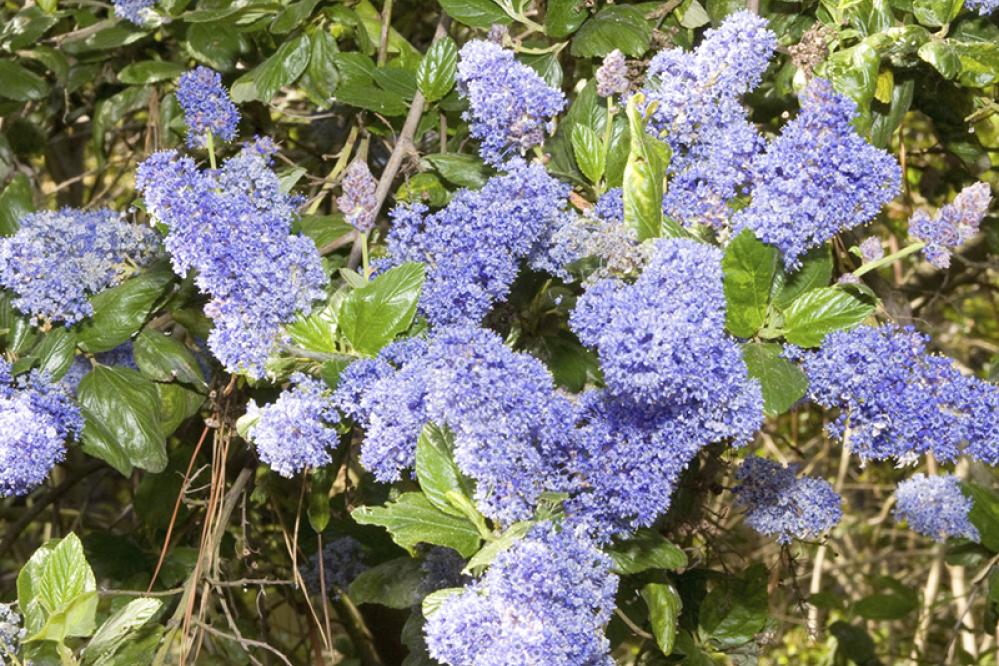
Blue Blossom

Scientific Name:
Ceanothus thyrsiflorus
Description

An evergreen (green throughout the year) shrub native to the west coast of North America, also commonly called “ceanothus” (see-ann-oh-thus). Its bluish purple to white flowers bloom from March to June.

More Information: This shrub can grow up to 3.7 m (12 ft) tall and 3.7 m (12 ft) wide.

Fun Facts

The leaves are rich in saponins, a substance that often makes plants taste bad to animals. You can also use the blossoms as a mild soap! The blossoms have a light, sweet scent reminiscent of lilacs. That's why another of the common names for Blue Blossom is California Wild Lilac. 

Further Reading

This is a most magnificent evergreen. It can be a widely branching shrub standing two feet tall or a small tree stretching out to over twenty feet. Three prominent nearly parallel veins mark its dark green elliptical to oval leaves which complement the stunning perfumed blossoms. Eye-catching dense clusters of tiny flowers varying in color from very light to dark blue grace this plant. Widely used as an ornamental landscape plant, it has been given special recognition by the Royal Horticultural Society of England.

It is especially important for both native bees and butterflies. Many birds enjoy its seeds; hummingbirds “savor” its nectar. This plant is native to California and southern Oregon. It is drought tolerant, preferring well-drained soils near the coast. While Native Americans utilized the plant as a dye and food, their use of its fresh or dried flowers as a gentle soap is more widely known.

Blue Blossom relies on