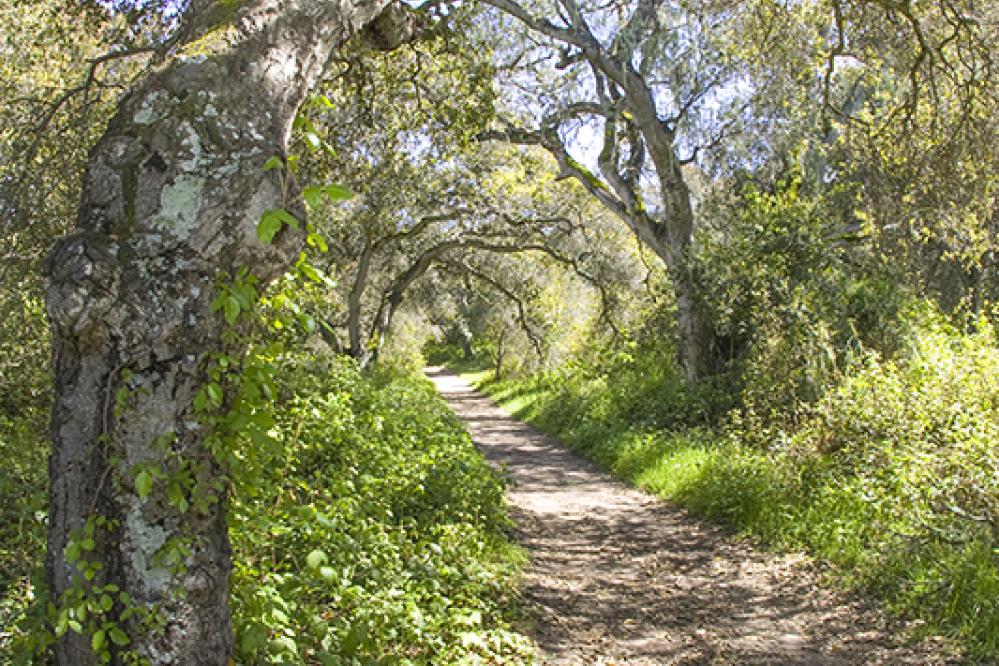
To appreciate an old coast live oak (Quercus agrifolia var. a.), one must stand beneath its shady dark hemispheric canopy which is supported by a twisted gray superstructure of gnarled branches. Multiple trunks are common, and the wide-spreading limbs sometimes trail along the ground. Its tough hard leaves are oval and convex, from one to three inches long; the margins are spiny and there are small hairs on the undersides. “Live” in its name means evergreen as opposed to deciduous; though it drops leaves throughout the year, it maintains its dense dark green crown. They commonly live more than 250 years.
Smooth gray bark becomes brownish and furrowed with age. Acorns are conical, ¾ to 1½ inches long, a rich reddish-brown in color. They were a staple food for many Native American tribes, and Spanish settlers associated the tree with fertile lands. While the wood grain was somewhat irregular to be used by pioneers in construction, it made fine charcoal for early industries. Mission builders used it to fire their lime kilns to make adobe mortar, and in fact the locations of the Franciscan missions closely match the coast live oak’s native range, from northern Baja California to Mendocino County.
Coast live oaks thrive on the well-drained soils of coastal plains, though not on the immediate shore. They are the most characteristic tree within a fifty-mile-wide swath from the ocean across the Inner Coast Ranges, where climate is mild and fog is common. Robert Louis Stevenson described the dense coast live oak forests around Monterey as “woods for murderers to crawl among.” Be that as it may, they are as much a part of western California as are its golden hills.

 Sun
Sun Water
Water Nutrients