Monterey Pine

Scientific Name:
Pinus radiata
Description

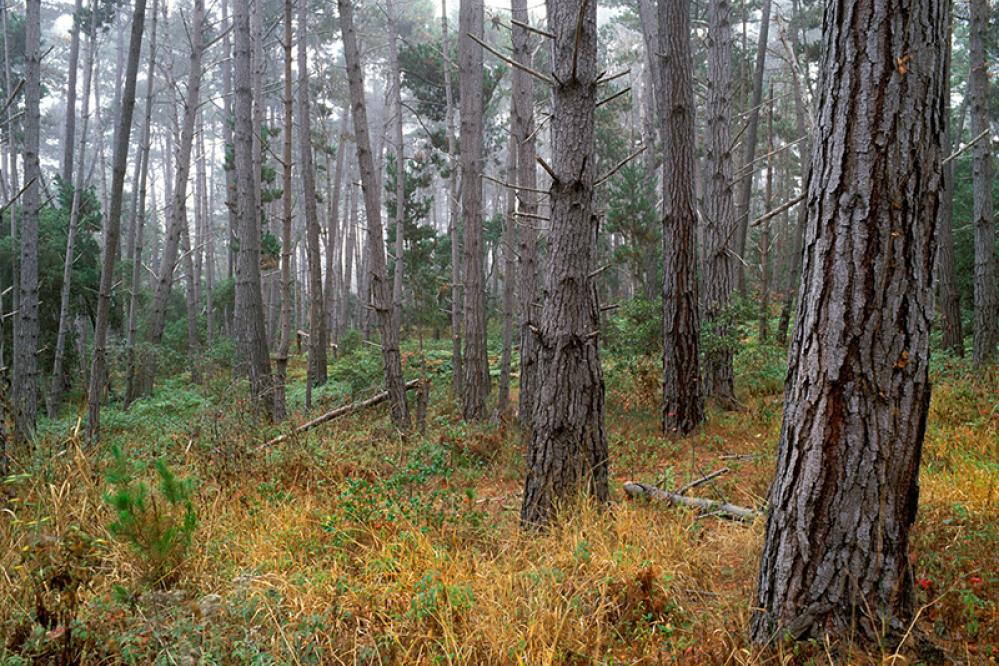
This large (over 37 m / 120 ft tall) tree was named for the Monterey Peninsula, the largest area where it grows naturally. It’s only native to three other small areas in California and Baja, but it has been planted all over the world. It grows long, bright green needles that exist in groups of three and produces medium-sized cones. Its dark gray to brown bark grows in a cracked or “fissured” pattern.
 

More information: It is coniferous, which means it reproduces using cones.

Behaviors

The Monterey pine is the most widely planted pine in the world, thanks to its fast growth rate and high adaptability.

Fun Facts

The Monterey pine is the most widely planted pine in the world, thanks to its fast growth rate and high adaptability.

Further Reading

Pinus radiata, Monterey pine, is perhaps the most widely planted of all pines, both for lumber and for landscaping, but it occurs naturally in only three places: Año Nuevo Point at the border of San Mateo and Monterey counties; Monterey peninsula from Monterey south to Mal Paso Creek (Carmel Highlands); and Cambria near San Simeon. A variant lives on two islands off Baja California, Mexico.

Monterey pine grows to 80-110 feet; it is symmetrical when young, with an irregular rounded crown at maturity (60-80 years). Its shape can also be distorted if it is crowded by other pines. In favorable conditions, i.e. near the coast, it can live to 100 years but has a much shorter life (less than 50 years) if planted inland. Needles grow in a bundle of three, 3-6 inches long.

Male cones grow in clusters on the tips of branches. Female cones are much larger, unevenly conical with little or no stalk, pointing downward. These cones can persist unopened on the tree for several years, and each year’s growth is marked by a radial cluster of cones around the branch. Monterey pine is a closed-cone pine; cones do not open as soon as the seeds ripen, but open only in response to heat. Unlike Bishop and knobcone pines, Monterey pine cones will open on a hot day as well as in a forest fire, but fire suppression raises questions about the long-term viability of this iconic tree.

Monterey Pine relies on