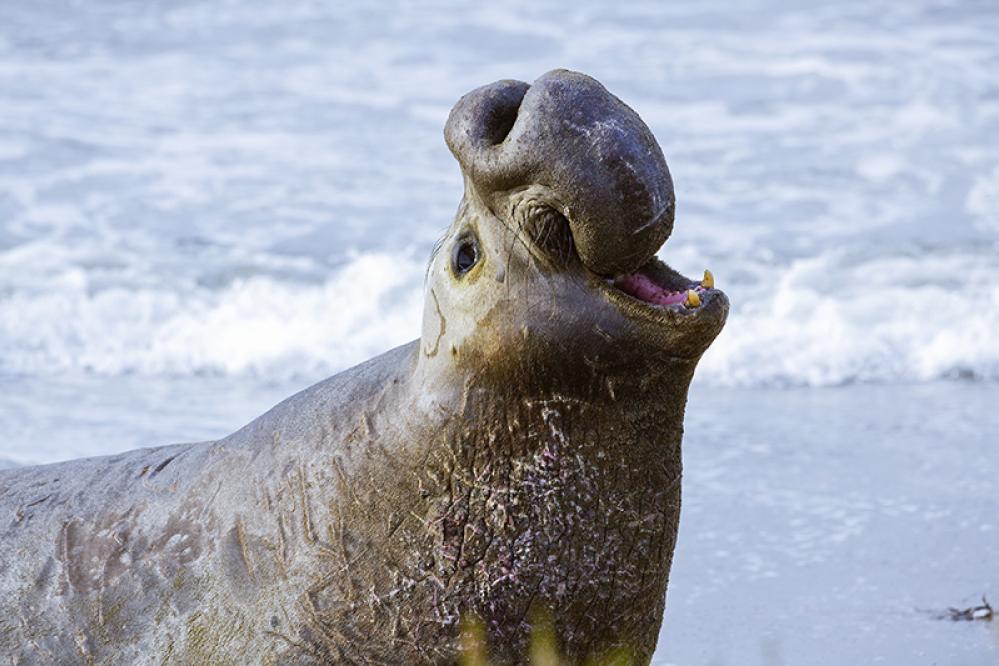
The northern elephant seal (Mirounga angustirostris) is an occasional visitor to Point Lobos. The adult male, with its large elongated nose, is enormous at over 2 tons and up to 16 feet; females are significantly smaller. Like harbor seals, elephant seals lack ear flaps and move on land by flopping along on the belly. If you look closely at an elephant seal you notice black whiskers instead of the harbor seal’s white whiskers. Sand flipping is another clue. An elephant seal flips sand on itself to help regulate body temperature.
Elephant seals are characterized by extraordinary behavior. They spend 80% of their life at sea foraging, only coming ashore to molt (shed hair and skin) and to mate for adults, or to rest for subadults. While at sea they lead a solitary life and cover long distances in search of food. Elephant seals dive deep in search of food. They are the deepest diving pinniped known with an average dive to 1800 feet and a maximum recorded depth of over 5000 feet.
The occasional sightings at Point Lobos might include a recently weaned pup who hasn’t learned to successfully forage and is suffering from malnutrition. The Marine Mammal Center rescues them, nurses them back to health and then releases them to the ocean. Subadults might also haul out on our beaches to rest. Less frequently an adult male might visit Point Lobos. Older animals rarely appear at Point Lobos.
For almost guaranteed elephant seal viewing, drive a couple hours to one of the nearby mainland rookeries. Ano Nuevo State Park is about 2 hours north of Point Lobos. Piedras Blancas rookery, the largest rookery, is a little over 2 hours drive to the south on the Big Sur coastline near San Simeon. Elephant seals haul out to molt at different times based on age and gender, so you can always see some elephant seals at the rookeries. Visit one of the rookeries during the winter birthing and breeding season for an amazing nature experience. In the not too distant past, elephant seals were highly endangered. They now number approximately 85,000.